
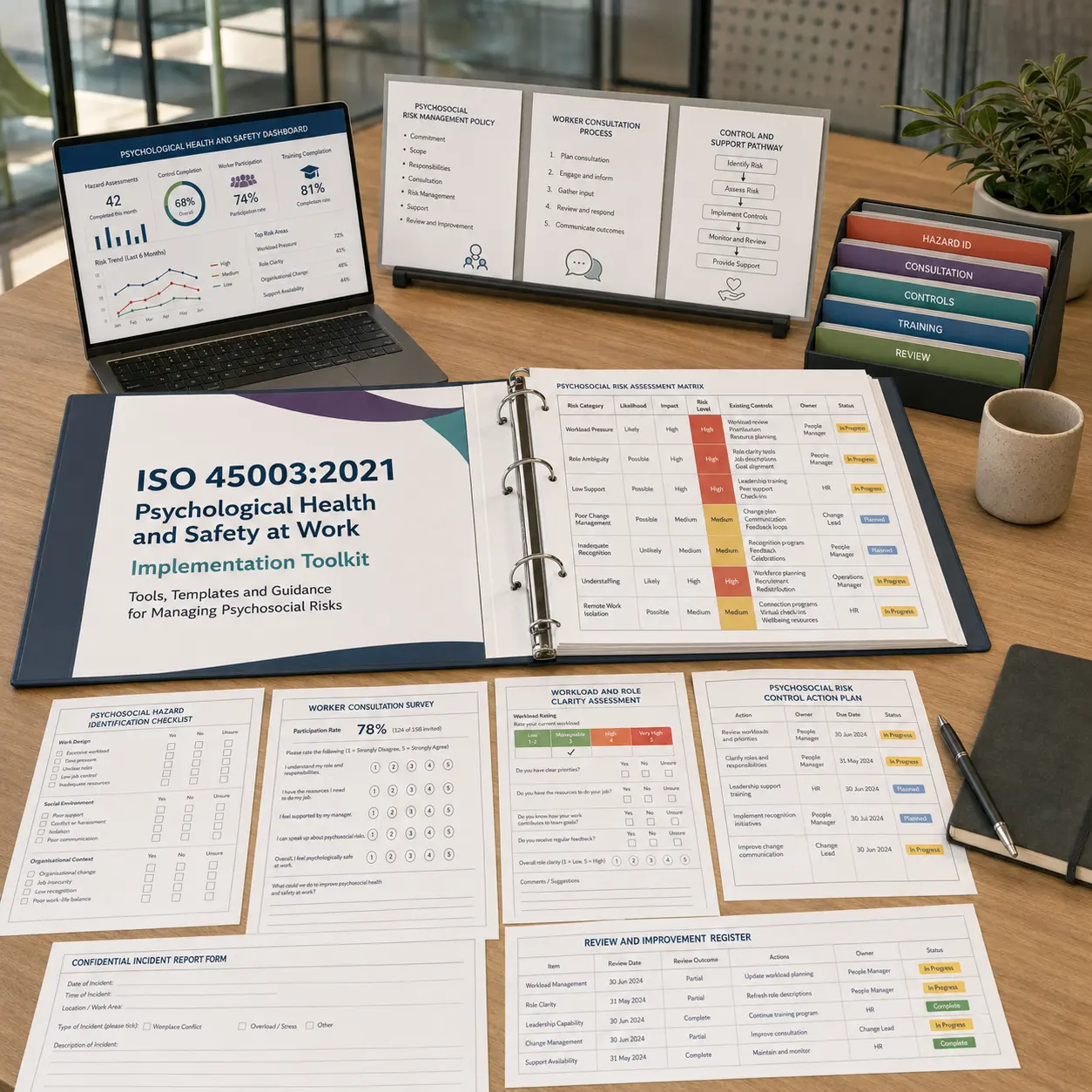
The ISO 45003:2021 Psychological Health and Safety at Work Implementation Toolkit provides a comprehensive, easy to use set of premium templates and professionally structured implementation resources to help organizations identify psychosocial hazards, assess psychosocial risks, implement effective controls, strengthen worker participation, and continually improve psychological health and safety at work.
Aligned with ISO 45003:2021 guidance, this toolkit translates psychosocial risk management principles into practical policies, procedures, assessments, registers, action plans, training materials, reporting tools, dashboards, and review documents. It supports integration with occupational health and safety and people management processes while helping organizations address work design, workload, role clarity, organizational change, bullying and harassment, critical incidents, worker support, performance evaluation, and continual improvement.
Implementing a structured psychosocial risk management approach can require significant coordination across leadership, occupational health and safety, HR, line management, worker representatives, and operational teams. Organizations need practical evidence for hazard identification, consultation, risk assessment, control planning, organizational change, incident response, worker support, monitoring, review, and continual improvement.
The ISO 45003:2021 Psychological Health and Safety at Work Implementation Toolkit provides a comprehensive collection of easy to use templates and structured implementation documents in Word, Excel, and PowerPoint formats. It helps your organization accelerate implementation, standardize psychosocial risk documentation, strengthen worker participation, improve control governance, integrate psychological health and safety with existing OH&S and people management processes, and demonstrate a systematic approach aligned with ISO 45003 guidance.

Below is the structured list of documents included in the package. Use the quick navigation or expand each part to review the files before downloading the index file.
 Part 1. Program Initiation & Baseline Assessment
 ISO 45003 Implementation Project Charter.docx
 Psychological Health & Safety Implementation Scope.xlsx ISO 45003 Current-State Assessment.xlsx Psychosocial Risk Management Maturity Assessment.xlsx Existing OH&S and HR Documentation Review.xlsx Gap & Improvement Action Plan.xlsx Integrated Implementation Plan.xlsx Project RACI Matrix.xlsx
 Project Kick-off Deck.pptx Baseline Assessment Executive Deck.pptx
Part 2. Organizational Context, Workforce Profile & Interested Parties
Organizational Context Assessment.xlsx Internal & External Issues Register.xlsx Workforce Profile & Work Arrangement Register.xlsx Interested Parties & Requirements Register.xlsx Legal, Regulatory & Other Requirements Register.xlsx Psychosocial Risk Context Mapping.xlsx Higher-Risk Worker Group Assessment.xlsx Remote, Hybrid, Shift & Lone Work Profile.xlsx Context Review Record.docx
Part 3. Leadership, Policy, Governance & Worker Participation
Psychological Health and Safety Policy.docx Psychosocial Risk Governance Framework.docx Leadership Responsibilities Matrix.xlsx Psychosocial Risk RACI Matrix.xlsx Worker Consultation & Participation Procedure.docx Worker Representative Register.xlsx Consultation & Participation Plan.xlsx Psychosocial Risk Steering Committee Terms of Reference.docx Governance & Review Calendar.xlsx Leadership Awareness Deck.pptx
Part 4. Psychosocial Hazard Identification
Psychosocial Hazard Identification Procedure.docx Psychosocial Hazard Taxonomy & Criteria.xlsx Psychosocial Hazard Identification Checklist.xlsx Work Design Hazard Assessment.xlsx Workload, Work Pace & Working Hours Assessment.xlsx Role Clarity, Job Control & Organizational Support Assessment.xlsx Organizational Culture, Leadership & Recognition Assessment.xlsx Interpersonal Conflict, Bullying, Harassment & Violence Assessment.xlsx Remote, Hybrid, Isolated & Mobile Work Assessment.xlsx Critical Incident & Traumatic Exposure Assessment.xlsx Psychosocial Hazard Register.xlsx
Part 5. Psychosocial Risk Assessment & Prioritization
Psychosocial Risk Assessment Methodology.docx Psychosocial Risk Assessment Criteria.xlsx Enterprise Psychosocial Risk Assessment Workbook.xlsx Business Unit & Team Psychosocial Risk Assessment.xlsx Psychosocial Risk Survey Questionnaire.docx Psychosocial Survey Results Analysis Workbook.xlsx Worker Focus Group & Interview Guide.docx Focus Group & Interview Findings Workbook.xlsx Psychosocial Risk Prioritization Matrix.xlsx Psychosocial Risk Register.xlsx Risk Assessment Approval Record.docx
Part 6. Psychosocial Risk Controls & Action Planning
Psychosocial Risk Control Framework.docx Psychosocial Risk Control Selection Matrix.xlsx Psychosocial Risk Treatment & Action Plan.xlsx Work Design Improvement Plan.xlsx Workload & Resourcing Improvement Plan.xlsx Leadership & Management Practice Improvement Plan.xlsx Team Climate & Communication Improvement Plan.xlsx Bullying, Harassment & Violence Prevention Action Plan.xlsx Control Implementation Tracker.xlsx Control Effectiveness Evaluation.xlsx Residual Psychosocial Risk Register.xlsx
Part 7. Organizational Change & Work Design Integration
Organizational Change Psychosocial Risk Procedure.docx Psychosocial Change Impact Assessment.xlsx Restructure & Role Change Risk Assessment.xlsx New Work System & Technology Change Assessment.xlsx Working Time & Shift Change Assessment.xlsx Remote & Hybrid Work Change Assessment.xlsx Change Consultation Plan.xlsx Change Risk Control Action Plan.xlsx Post-Change Psychosocial Risk Review.docx
Part 8. Competence, Awareness & Manager Capability
Psychosocial Risk Competence Matrix.xlsx Training Needs Analysis.xlsx Annual Psychological Health & Safety Training Plan.xlsx Executive Psychological Health & Safety Awareness Deck.pptx Manager Psychosocial Risk Training Deck.pptx Worker Psychological Health & Safety Awareness Deck.pptx HR & OH&S Practitioner Training Deck.pptx Training Attendance & Competence Register.xlsx Training Effectiveness Evaluation Form.docx Manager Psychological Health Conversation Guide.docx
Part 9. Communication, Reporting, Confidentiality & Worker Support
Psychological Health & Safety Communication Plan.xlsx Psychosocial Concern Reporting Procedure.docx Confidential Psychosocial Concern Reporting Form.docx Psychosocial Concern & Case Register.xlsx Psychosocial Concern Escalation & Response Matrix.xlsx Confidentiality & Information Handling Protocol.docx Worker Support Resources Directory.xlsx Worker Support Referral Form.docx Psychological Emergency Support Contact Sheet.xlsx Communication & Awareness Tracker.xlsx
Part 10. Psychological Incident Response, Recovery & Return to Work
Psychological Injury & Critical Incident Response Procedure.docx Critical Incident Psychological Response Plan.docx Psychological Incident Report Form.docx Immediate Support & Escalation Checklist.docx Post-Incident Review Template.docx Recovery & Workplace Accommodation Plan.docx Psychological Return-to-Work Plan.docx Return-to-Work Coordination Record.docx Recovery Action Tracker.xlsx Incident Lessons Learned Register.xlsx
Part 11. Integration with OH&S and People Management Processes
ISO 45001 & ISO 45003 Integration Matrix.xlsx Psychosocial Risk Integration Control Matrix.xlsx Job Design & Role Review Checklist.xlsx Performance Management Psychosocial Risk Checklist.xlsx Working Time & Flexible Work Risk Checklist.xlsx Contractor & Temporary Worker Psychosocial Risk Checklist.xlsx Procurement & Supplier Psychosocial Requirements Checklist.xlsx Workplace Change Psychosocial Risk Integration Checklist.xlsx
Part 12. Monitoring, Measurement & Performance Evaluation
Psychosocial Risk KPI & KRI Register.xlsx Psychological Health & Safety Performance Dashboard.xlsx Psychosocial Hazard Trend Tracker.xlsx Psychosocial Pulse Survey Questionnaire.docx Psychosocial Survey Trend Analysis Workbook.xlsx Psychological Incident & Absence Trend Register.xlsx Psychosocial Control Effectiveness Review.xlsx Risk Treatment Action Closure Tracker.xlsx Worker Consultation & Participation Effectiveness Review.xlsx Annual Psychological Health & Safety Performance Report.docx Performance Review Deck.pptx
Part 13. Internal Review & Management Review
ISO 45003 Internal Review Checklist.xlsx Psychosocial Risk Management Process Review.xlsx Worker Consultation & Participation Review.xlsx Psychosocial Control Effectiveness Review Checklist.xlsx Review Findings Register.xlsx Corrective Action Tracker.xlsx Management Review Input Pack.xlsx Management Review Agenda.docx Management Review Presentation.pptx Management Review Minutes.docx Management Review Decision & Action Register.xlsx
Part 14. Continual Improvement, Handover & Sustainment
Psychosocial Risk Nonconformity & Corrective Action Form.docx Root Cause Analysis Template.docx Psychological Health & Safety Improvement Opportunities Register.xlsx Continual Improvement Action Plan.xlsx Lessons Learned Register.xlsx Annual Psychosocial Risk Management Plan.xlsx Annual Assessment & Survey Calendar.xlsx Policy, Risk & Control Review Calendar.xlsx Psychological Health & Safety Maturity Reassessment.xlsx Operational Handover Checklist.xlsx Consultant Handover Checklist.xlsx Final Implementation Report.docx Final Executive Handover Deck.pptxReview the complete file index, preview free sample templates, or check the purchase and payment guide.
| Date File Updated | 25/03/2025 |
| File Format | pdf, xls, doc, docx, xlsx, pptx |
| No. of files | 158 File; 14 Folders |
| File download size | 20.17 MB (rar). |
| Language |
 English
|
| Purchase code | ISO45003-Toolkits |
The psychosocial hazard checklist helped managers discuss workload, role clarity, support, and communication in a much more concrete way.
The action plan is useful because every control has a responsible owner, target date, status, and effectiveness review.
The worker consultation templates gave us a consistent structure for focus groups and follow-up actions across departments.
The organizational change checklist is a strong tool for identifying psychosocial risks before restructuring or technology changes.
The toolkit fits naturally alongside ISO 45001 because it uses familiar risk assessment, action, monitoring, and review concepts.
The manager guidance is practical and makes it easier to translate psychosocial risk requirements into everyday supervisory actions.
The communication and awareness materials are useful for explaining why psychosocial risk management is more than an employee survey.
The monitoring dashboard helps us see open actions and recurring themes without creating an overly complicated reporting process.
The management review template keeps psychosocial risk on the leadership agenda after the initial assessment is completed.
The remote and hybrid work considerations were relevant for teams working across multiple locations and time zones.
The implementation path is clear enough for smaller organizations but can also be expanded for a larger workforce.
The combination of hazard identification, consultation, controls, monitoring, and continual improvement makes the package easy to integrate into an OH&S framework.