
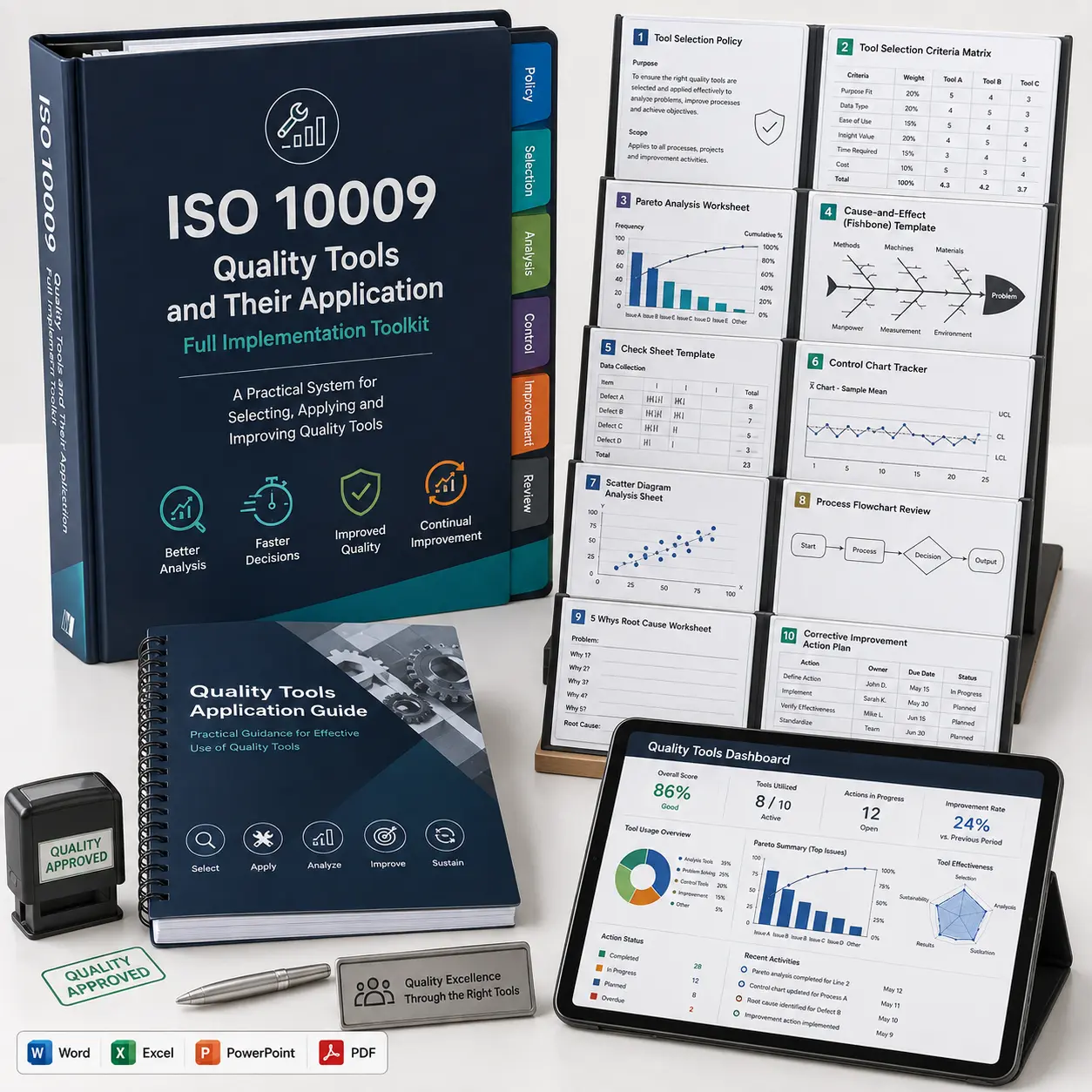
The ISO 10009:2024 Quality Tools Implementation Toolkit provides a structured collection of editable templates, workbooks, checklists, reports, and training resources to help organizations select, apply, review, and improve the use of quality tools in a consistent and evidence-based manner.
Aligned with ISO 10009:2024 guidance for quality tools and their application, the toolkit supports practical work across quality-tool selection, data collection, process characterization, statistical analysis, process stability and capability, root-cause analysis, risk-based decision making, improvement planning, competence, deployment, and continual improvement.
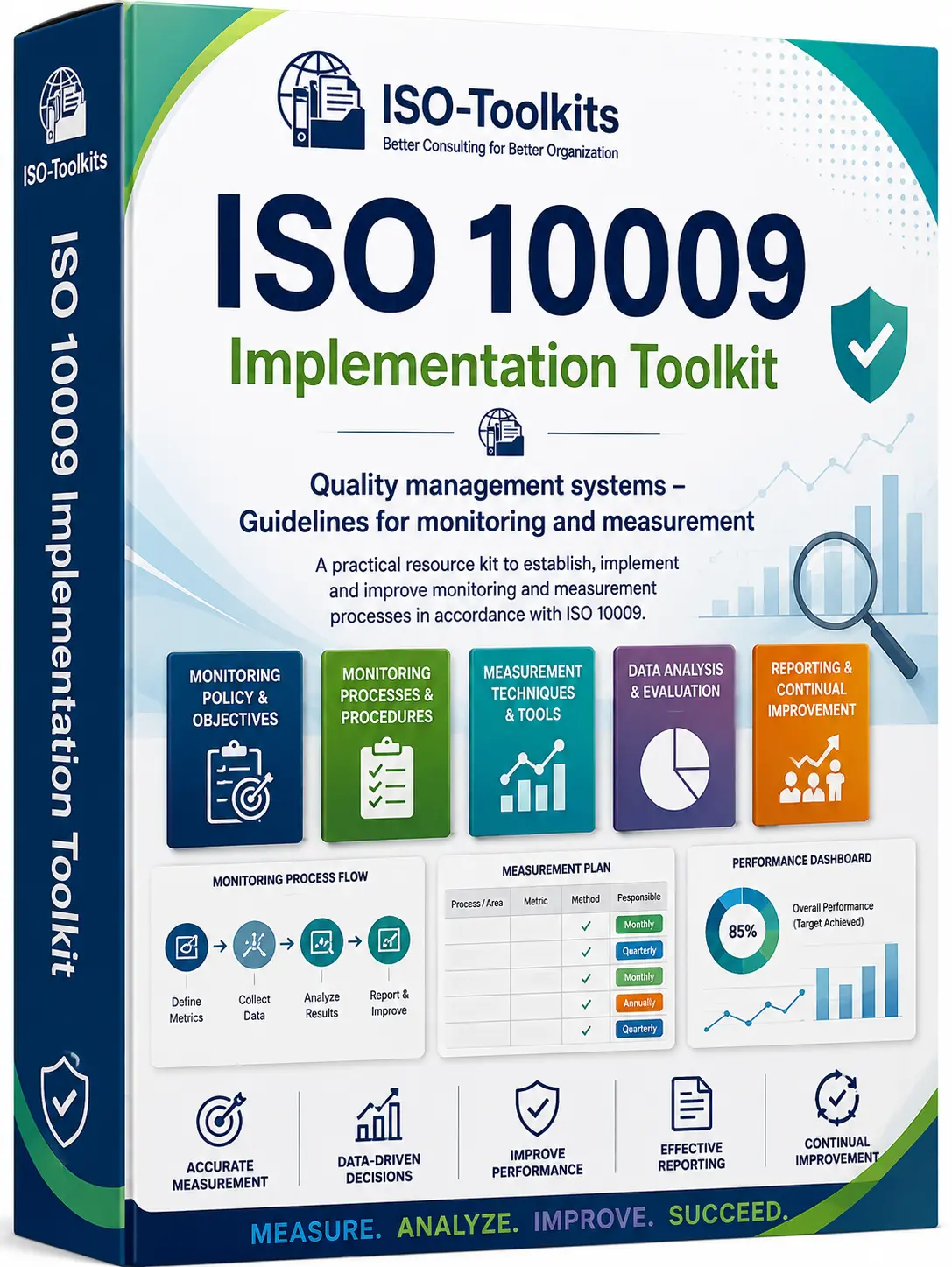
Building a consistent quality-tool system requires more than a collection of isolated worksheets. Organizations need clear criteria for choosing the right tool, reliable data collection methods, repeatable analysis templates, structured problem-solving methods, and practical controls for reviewing whether each tool is being applied effectively.
The ISO 10009:2024 Quality Tools Implementation Toolkit provides a comprehensive collection of editable templates and structured implementation resources in Word, Excel, and PowerPoint formats. It helps teams standardize tool selection, analyze process data, investigate causes, prioritize actions, evaluate solutions, and sustain improvement with stronger consistency and traceability.

Below is the structured list of documents included in the package. Use the quick navigation or expand each part to review the files before downloading the index file.
 Part 1. Program Initiation & Quality Tool Applicability
 ISO 10009 Implementation Charter.docx
 Quality Tools Applicability Assessment.xlsx Current Quality Tools Practice Assessment.xlsx Existing Quality Tool Inventory.xlsx Quality Tool Usage Gap Assessment.xlsx Implementation Gap & Action Plan.xlsx Quality Tools Implementation Roadmap.xlsx Quality Tools Roles & RACI Matrix.xlsx
 Project Kick-off Deck.pptx
Part 2. Quality Tool Selection Framework & Standardization
Quality Tools Selection Framework.docx Quality Tool Selection Decision Matrix.xlsx Problem / Objective-to-Tool Selection Matrix.xlsx Quality Tool Applicability & Limitations Matrix.xlsx Quality Tool Selection Checklist.xlsx Standard Quality Tool Catalogue.xlsx Quality Tool Template Library Index.xlsx Quality Tool Owner & Facilitator Register.xlsx Quality Tools Selection Guide.pptx
Part 3. Data Collection, Measurement & Sampling
Data Collection Plan.xlsx Operational Definition Sheet.docx Data Source & Ownership Register.xlsx Check Sheet Template.xlsx Sampling Plan.xlsx Measurement Adequacy Checklist.xlsx Data Quality Validation Checklist.xlsx Data Collection & Observation Log.xlsx Measurement and Sampling Review Record.docx
Part 4. Process Characterization & Mapping Tools
SIPOC Analysis Workbook.xlsx Process Flowchart Template.xlsx Cross-Functional Process Map.xlsx Process Input-Output Analysis.xlsx Critical-to-Quality Characteristics Register.xlsx Process Performance Baseline Workbook.xlsx Process Bottleneck Analysis.xlsx Process Waste & Constraint Observation Sheet.xlsx Process Characterization Summary Report.docx
Part 5. Data Analysis & Visualization Tools
Pareto Analysis Workbook.xlsx Histogram Analysis Workbook.xlsx Scatter Diagram Workbook.xlsx Stratification Analysis Workbook.xlsx Run Chart Workbook.xlsx Box Plot Analysis Workbook.xlsx Trend Analysis Workbook.xlsx Descriptive Statistics Workbook.xlsx Data Analysis Findings Summary.docx
Part 6. Process Stability, Variation & Capability Tools
Control Chart Selection Guide.xlsx Control Chart Workbook.xlsx Process Stability Assessment.xlsx Process Capability Analysis Workbook.xlsx Process Performance Analysis Workbook.xlsx Common Cause & Special Cause Analysis.xlsx Variation Source Analysis.xlsx Process Reaction Plan.docx Stability & Capability Review Report.docx
Part 7. Problem Solving & Root Cause Analysis Tools
Structured Problem-Solving Worksheet.xlsx Problem Statement & Evidence Sheet.docx 5-Why Analysis Template.docx Cause-and-Effect Diagram Workbook.xlsx Cause Validation Matrix.xlsx Is / Is Not Analysis.xlsx Root Cause Evidence Log.xlsx A3 Problem-Solving Report.docx 8D Problem-Solving Report.docx Corrective Action Selection Matrix.xlsx Corrective Action Plan.xlsx Action Effectiveness Verification Form.docx
Part 8. Risk, Prioritization & Decision-Making Tools
Risk Assessment Matrix.xlsx FMEA Workbook.xlsx Prioritization Matrix.xlsx Decision Matrix.xlsx Multi-Criteria Decision Analysis.xlsx Cost-Benefit Analysis.xlsx Risk-Based Action Prioritization.xlsx Solution Selection Matrix.xlsx Decision & Rationale Record.docx
Part 9. Improvement, Optimization & Planning Tools
PDCA Improvement Charter.docx Improvement Opportunity Register.xlsx Process Improvement Plan.xlsx Before-and-After Performance Analysis.xlsx Pilot & Trial Plan.docx Design of Experiments Planning Workbook.xlsx Solution Evaluation Matrix.xlsx Improvement Benefits Validation.xlsx Control & Standardization Plan.xlsx Affinity Diagram Workbook.xlsx Relations Diagram Workbook.xlsx Tree Diagram Workbook.xlsx Matrix Diagram Workbook.xlsx Process Decision Program Chart Workbook.xlsx Activity Network Planning Workbook.xlsx Improvement Results Report.docx
Part 10. Competence, Deployment, Review & Continual Improvement
Quality Tools Competence Matrix.xlsx Quality Tools Training Needs Analysis.xlsx Annual Quality Tools Training Plan.xlsx Quality Tools Practitioner Training Deck.pptx Quality Tools Facilitator Guide.docx Quality Tool Application Review Checklist.xlsx Quality Tool Usage Register.xlsx Quality Tool Effectiveness Assessment.xlsx Quality Tools Performance Dashboard.xlsx Quality Tools Lessons Learned Register.xlsx Quality Tool Template Improvement Register.xlsx Quality Tools Maturity Reassessment.xlsx Annual Quality Tools Review Plan.xlsx Operational Handover Checklist.xlsx Final Implementation Report.docx Final Executive Handover Deck.pptxReview the complete file index, preview free sample templates, or check the purchase and payment guide.
| Date File Updated | 25/03/2025 |
| File Format | pdf, xls, doc, docx, xlsx, pptx |
| No. of files | 107 File; 10 Folders |
| File download size | 10.12 MB (rar). |
| Language |
 English
|
| Purchase code | ISO10009-Toolkits |
The problem-to-tool selection matrix is a useful reference when teams are unsure whether to use Pareto, FMEA, control charts, or root cause tools.
The check sheet and data collection plan made our first improvement workshop much more organized.
The Pareto and trend analysis workbooks are easy to adapt and produce results that managers can understand quickly.
The process mapping section is very practical for identifying bottlenecks, handoffs, and critical-to-quality characteristics.
The control chart selection guide helped our team choose the correct chart instead of using one format for every type of data.
The 8D and corrective action templates provide a clear structure for customer and supplier issue resolution.
The capability workbook is useful because the calculation and interpretation steps are organized in one place.
The risk and prioritization tools help teams move from a long list of issues to a realistic improvement plan.
The decision matrix and cost-benefit analysis are very useful when several improvement options are competing for resources.
The A3 template is concise enough for management review but still captures evidence, root cause, actions, and results.
The competence matrix and training plan are helpful for building a structured quality tools development program.
The toolkit covers the full cycle from data collection and analysis through problem solving, decision making, implementation, and review.